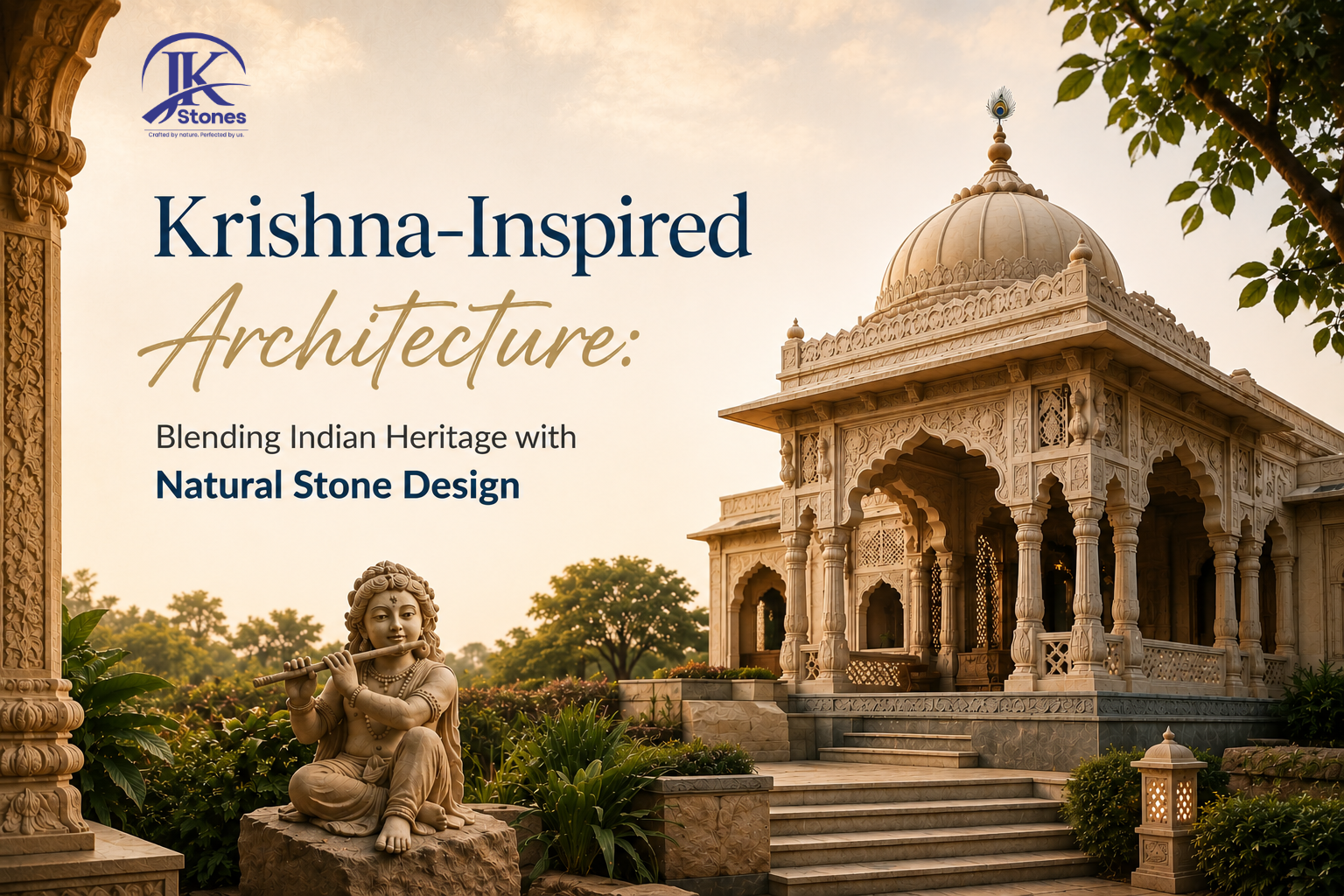
In India, the role played by Krishna is not limited only to temple architecture and related sculptures and art pieces. Krishna’s presence can be traced in the landscapes of Vrindavan, Govardhan and Dwarka, as well as in sculpture and architecture.
Contemporary Krishna architecture can draw from the same sources of inspiration, creating unique projects of the modern times. Krishna-inspired architecture is not limited by any fixed formula or historical architectural style. It can take into consideration Indian temple architecture, Krishna-related motifs, traditional craftsmanship and natural landscapes associated with Krishna.
Natural stone becomes a part of this approach to the architecture of today, connecting contemporary spaces with India’s rich stone architecture heritage.
What Is Krishna-Inspired Architecture?
There is no set of rules regarding the architectural appearance of the Krishna temples.
The Krishna temples in India represent various regional architectural styles. Thus, the Dwarkadhish Temple in Gujarat has prominent shikhara and highly sculpted architectural elements, while the Krishna Temple at Hampi belongs to the Vijayanagara architectural tradition.
It means that modern Krishna-inspired design can focus on the following principles:
- Proportions of the Indian architecture
- Materials
- Craftsmanship of the stone
- Motifs
- Courtyards
- Connection with nature and water
The purpose of such a design approach is the reinterpretation of the elements of Indian heritage for contemporary spaces.
Why Natural Stone Fits This Approach Perfectly
As it was mentioned before, natural stone has been widely used in India’s architecture for centuries.
Thus, such ancient sites as Khajuraho show the extensive use of sandstone, while Hampi reveals the use of local granite. Modern Krishna architecture preserves this tradition too.
An example of it can be Prem Mandir in Vrindavan. According to its official website, the temple is constructed of the white Italian Carrara marble and has granite foundation. Moreover, the exterior of the temple has carved panels representing the pastimes of Radha and Krishna.
It means that stone can combine the following aspects:
- Performance
- Craftsmanship
- Cultural story
- Architectural beauty
Natural Stone Designs for Krishna-Inspired Contemporary Homes
One does not need to construct a temple to bring Krishna’s influence into the modern residence.
1. Krishna-Inspired Feature Walls
Designers can clad walls with natural stone to create the backdrop for:
- Krishna art
- Carved panels
- Patterns inspired by the flute
- Lotus motifs
- Stone screens
Subtle design can bring cultural meaning into the interior without overloading it.
2. Courtyards with Natural Stone
Indian architecture often incorporates open courtyards.
Natural stone pavement can outline the courtyard and bring the architectural space closer to the outdoors, greenery, sunlight and seating areas.
Think about incorporating:
- Stone flooring
- Vegetation
- Traditional Indian seats
- Low lighting fixtures
- Miniature water features
3. Outdoor Spaces Based on Traditional Indian Mandapas
Mandapa is a traditional gathering space with columns used in Indian temple architecture.
Contemporary pavilion can be designed according to this pattern with:
- Stone columns
- Covered seats
- Open-sided structure
- Decorative stonework
This will provide a functional gathering place while referring to Indian architectural tradition.
Integrate Krishna’s Design Motifs into Natural Stone Elements
Visual identification of Krishna provides some motifs which can be translated into contemporary stone design.
The Flute
Flute is one of the most recognizable features of Krishna.
There is no need to incorporate a sculpture but stone can be used to make lines inspired by a flute.
The Peacock Feather
The peacock feather is strongly associated with images of Krishna.
It can inspire:
- Carved stone decoration
- Decorative panels
- Wall inlays
- Screens
- The Lotus
Lotus Imagery
It can be used in:
- Floor medallions
- Doorway decoration
- Columns
- Wall carving
- Borders
These examples should be considered as design ideas rather than architectural rules.
Get Design Ideas from Krishna’s Cultural Landscape
The cultural landscape of Krishna is associated with places like Vrindavan, Govardhan and Yamuna.
Landscape can be an important part of the architectural idea.
Contemporary architectural space can combine:
- Natural stone pathways
- Gardens
- Courtyards
- Water features
- Stones seats
- Sculptural elements
Natural materials can help create a visual connection between the architecture and the surroundings.
Stone, Water and Outdoor Areas
Water has a strong connection with Indian architectural landscapes.
Architectural complexes of ancient Indian temples, such as Hampi and Modhera, provide examples of using water features, tanks and landscaped areas as an integral part of the architectural landscape.
In case of a modern Krishna-inspired property, natural stone can be used around:
- Reflecting pools
- Fountains
- Garden water features
- Courtyards
- Steps
Stone should always be chosen according to its technical suitability for wet or outdoor applications.
Choosing the Proper Natural Stone
The choice of stone depends not only on symbolic but also on technical requirements of the application.
Before choosing a stone, consider:
- Durability
- Water exposure
- Surface finish
- Slip resistance
- Climate conditions
- Maintenance
- Installation
A good natural stone supplier would be able to assist in identifying natural stone material appropriate for different purposes, whether cladding and paving, or steps and ornaments.
Conclusion
Krishna-inspired architecture is not an architectural style based on one formula or another. It is based on the ability of the designer to wisely use the heritage of India, its culture, craftsmanship and landscapes connected with Krishna.
Natural stone will be the way to implement these influences in contemporary houses, hotels, cultural facilities and temples.
Whether it will be stone walls decorated with carved motives, courtyards, paths, landscaped water features – natural stone will be able to provide the opportunity to reflect Indian culture through architecture.
With proper choice of stone material, finish and installation the natural stone will become the way of connecting traditional craftmanship with modern architecture.
FAQS
Q1: Is there a special Krishna architectural style?
A: No. Krishna temples can be found in various styles of regional architecture. Krishna-inspired architecture can be considered as the contemporary approach to the design of Krishna-based projects.
Q2: Which natural stones can be used for Krishna-inspired projects?
A: Sandstone, granite and marble can be used according to the purpose. Selection of stone should be based on the durability of the stone, environment, finish and installation.
Q3: How can I implement Krishna-inspired motives in my modern home?
A: You can apply subtle motives such as flute, peacock feather and lotus motives, natural stone feature walls, courtyards, paths and landscape elements.
Q4: Can natural stone be applied in outdoor Krishna-inspired projects?
A: Yes. Suitable natural stone can be applied in paving, paths, courtyards and other landscape elements. Choice of stone and finish should be made according to the environmental and safety requirements.
Q5: Why should I apply to the natural stone supplier for such a project?
A: A good natural stone supplier will be able to help you to choose proper materials, finishes and sizes for your needs.