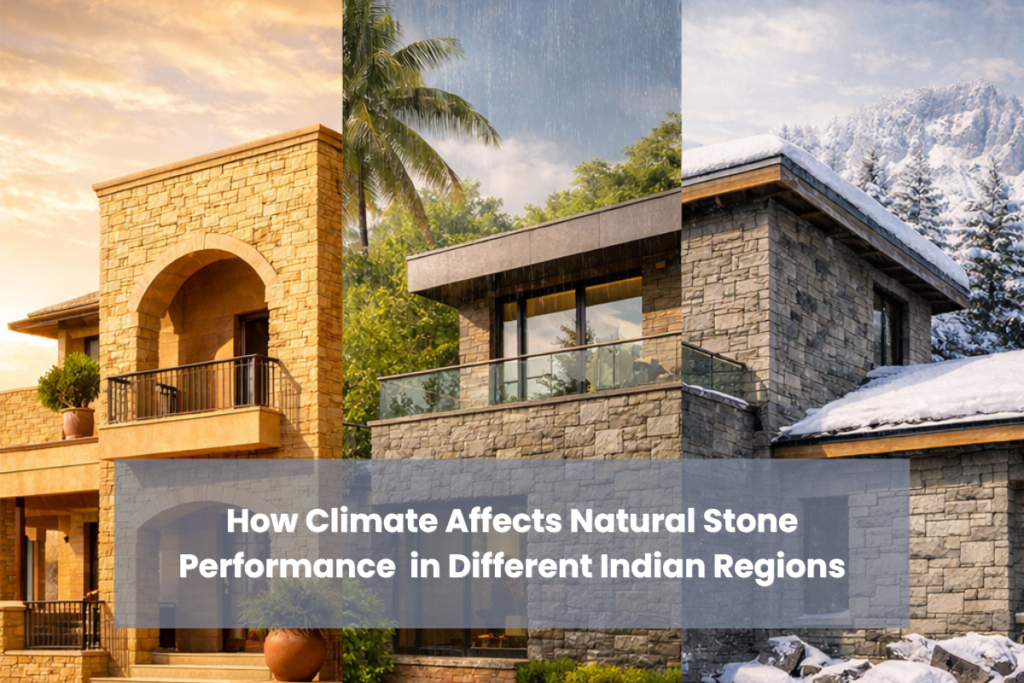
From severe heat in Rajasthan to heavy rainfall in Kerala and cold temperatures in the north, it is an important factor when it comes to how natural stones perform over time. Whether you are stuck researching stone cladding or exterior cladding stone, understanding environmental change makes it simple to choose the best material for strength, durability and looks for long-term value.
How Climate Affects Natural Stone
Natural stones have very high durability, and its performance can rely on environmental conditions like temperature change, moisture, and sun exposure. Factors like thermal expansion, water absorption, and weathering can influence the longevity of stones.
For example, sudden changes in temperature can result in thermal shock for some materials but not others such as sandstone and limestone which are more heat sensitive
Natural Stone Performance in Hot and Dry Regions
In regions like Rajasthan, Gujarat, and parts of Madhya Pradesh comes under the extreme heat and dry conditions. Here, stones need to resist high temperatures and UV exposure.
- Kadappa stone is relatively heat – resistant and naturally maintains the coolness, so it works best as outdoor stone in changeable temperatures.
- Sandstone is another suitable option which holds its colour and does not fade even after long-term exposure to the sun.
Performance in Coastal and Humid Regions
Coastal regions, such as Mumbai, Chennai and Kerala, have high humidity and exposure to salt that can also affect the longevity of stones.
- In these regions, stones used for stone cladding must be low porosity so that no water and salt damage occurs.
- Kadappa stone is dense and less porous, making it suitable for flooring as well as outdoor usage in humid climates.
- For paving stone, proper sealing is required to prevent this stone from moisture damage such as staining and erosion.
Performance in Rainy and Monsoon-Prone Areas
In areas of high rainfall, stones need to be slip resistant and waterproof.
- Sandstone is naturally slip-resistant, which makes it well-suited for wet weather outdoor paving.
- Paving stone is used in such areas that allows water drainage and minimizes the formation of ponds.
- For use as exterior cladding stone, proper installation and sealing is critical to prevent seepage that can result in long-term damage.
Performance in Cold and Hilly Regions
Northern states and hill regions have low temperatures leading to freezing temperatures.
- The stones used should have high compressive strengths to withstand expansion and contraction forces.
- Stones that are frost resistant and do not crack easily are the best choices for stone cladding in such an environment.
- Natural Indian stones like sandstone show a good resistance to temperature changes and can stay long-lasting with maintenance.
Selection of Natural Stones Depending on Their Performances in Varied Weather Conditions
Selecting the right natural stone depends on matching its properties with the regional climate:
- Kadappa stone – The best choice in hot and humid environments due to their durable and cooling properties
- Sandstone – Suitable for outdoors where weather condition is wet and dry
- Paving stone – Suitable for landscaping, walkways, driveways, and floors with good drainage
While selecting stone cladding and exterior cladding stones, certain characteristics should be kept in mind.
Conclusion
The climate becomes very important while deciding on the durability and performance of the natural stones. If we are able to understand the climate area and select the appropriate stones, such as Kadappa stone, Sandstone, or Paving stone, then the results would be effective, safe, and aesthetically beautiful.