
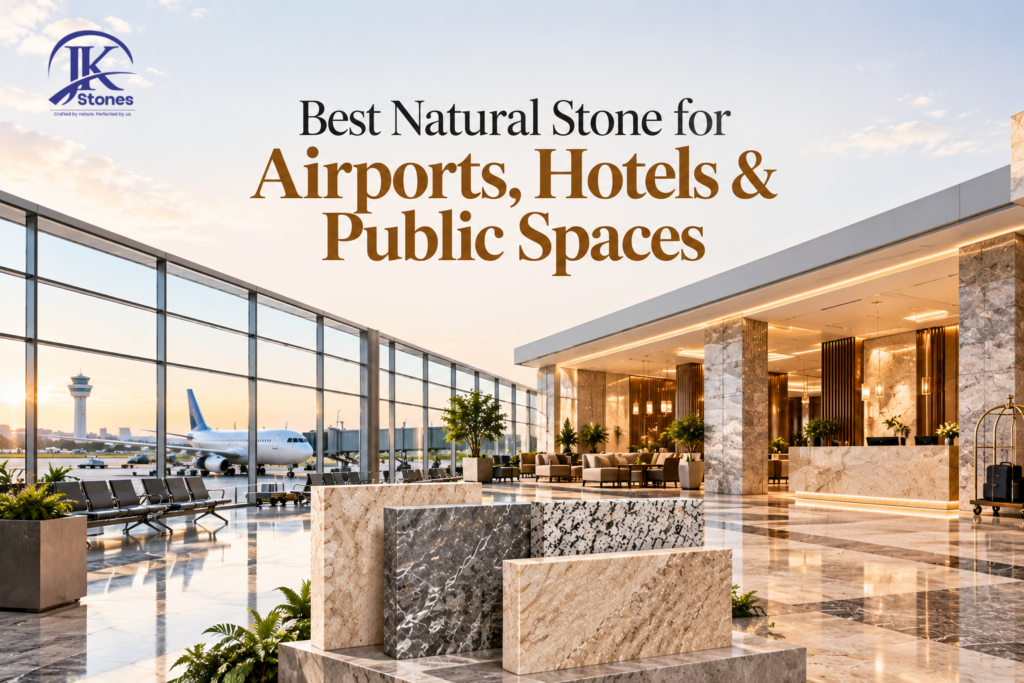
Airports, hotels and public spaces see lots of activity. Thousands of people walk through their floors each day, while luggage, cleaning equipment, moisture and outdoor dirt cause additional wear.
These are all reasons to use natural stone on many projects, but there isn’t a stone which could be considered always perfect for any job. It all depends on the intended purpose of the project.
Start With the Project, Not the Stone
An airport terminal and a luxury hotel lobby have their own needs. Just like an outdoor public plaza and an indoor restaurant.
Before selecting a stone, it is important to know:
- Level of the anticipated foot traffic
- Indoors or outdoors
- Will the floor be in contact with water
- Cleaning frequency
- Likelihood of stains or spills
- Desired finish of the surface
- Maintenance needs
With all this information at hand, the choice of natural stone will become obvious.
Granite for High-Traffic Areas
If a project has lots of constant movement going on, natural stone is often considered.
Its durability and resistance to wear make suitable varieties valuable for tough flooring applications. Granite has been used for airport passenger areas and other public spaces where flooring needs to withstand significant daily traffic.
However, not all granites will be equally applicable. Specific stone, finish, and application should be evaluated before approval.
For flooring with heavy traffic, project teams might consider the following:
- Abrasion resistance
- Compressive strength
- Flexural strength
- Water absorption
- Slip performance
Sandstone for Outdoor Public Spaces
Natural stone is not limited to indoor flooring only.
Sandstone can be used for outdoor installations, such as pathways, courtyards, plazas and landscaped public spaces if it is fit for this purpose.
Outdoor installations require special considerations, such as exposure to weather conditions, moisture, pedestrian traffic, surface finish and maintenance.
The natural color and texture of sandstone can fit nicely into gardens, heritage-inspired spaces and modern landscape architecture.
The Stone Name Is Just the First Thing to Consider
A frequent error is thinking that knowing what type of stone it is will give you enough information.
The natural stone may have different characteristics depending on the stone material, origin and finish. Large-scale commercial projects usually have technical data and necessary testing as a condition for approval.
Depending on the application, testing can include:
- Abrasion resistance
- Water absorption
- Compressive strength
- Flexural strength
- Slip resistance
Also, there are Indian Standards for different types of natural building stones.
The Surface Finish Plays an Important Role
The same stone will look different depending on the finish it has.
Polished finish may provide a high-gloss, premium appearance while honed finish has a soft appearance. Textured finishes may be considered for outdoor applications or places exposed to moisture.
There is no single “best” finish.
It will depend on location, traffic, exposure to water, safety requirements, and maintenance. In case of slip risk, the actual finish should be evaluated.
Consider Maintenance Requirements
Public spaces cannot be maintained in the same way that residential interiors.
Hotel lobbies, airport terminals, and public buildings are subject to frequent cleaning and constant usage throughout the day. Foot traffic, dirt, moisture and even spills can influence the surface over time.
That is why maintenance considerations should be taken into account at the stage of specifying stone.
The team might have to consider:
- Cleaning requirements
- Sealing requirements
- Stain management
- Expected surface wear
- Replacement and repair considerations
In other words, the initial price of the stone will only be a part of its total value.
Massive Projects Require a Reliable Supplier
One more aspect that comes into play when specifying natural stone for massive project is consistency.
Airports and hotels may require significant quantities of the same stone. Color, dimensions, finish and quality should be consistent to maintain uniformity of the look in large spaces.
That is why the stone selection process also involves choosing a reliable natural stone supplier.
Such a supplier should be capable of providing:
- Bulk materials
- Consistent quality
- Technical Documentation
- Quality Control
- Proper Packaging
- Timely Delivery Schedule
So, What Is the Best Natural Stone?
The selection will depend on the intended use.
Granite is a good fit for heavy traffic flooring. Marble may work fine in upscale hospitality environments where aesthetics play an important role. Sandstone may be suitable for selected outdoor public applications.
But the primary principle is very clear select the stone that fits your needs and demands of the space you are working with, not only aesthetically but from the performance point of view.
When you look at the performance, finish, maintenance and design together, natural stone is a practical option for your heavily used spaces.
FAQs
Q1: What natural stone is better to use for airport flooring?
A: Appropriate granite may be considered for airport flooring applications, depending on the demands of the project.
Q2: Is marble good for hotels?
A: Yes. Marble can be used in hotel lobbies and other premium interiors, as long as the demands for performance, maintenance and moisture are appropriate.
Q3: Can sandstone be used in public applications?
A: Yes. Appropriate sandstone may be used for selected outdoor applications such as walkways, courtyards and plazas.
Q4: What should one verify before choosing natural stone?
A: It is important to evaluate traffic resistance, wear resistance, water absorption rate, durability, slip resistance, surface finish, maintenance, and material consistency when choosing natural stone.
Q5: Why do we need testing for commercial applications?
A: Testing allows project managers to determine whether a particular stone fulfills the performance criteria of its application rather than just its visual properties or name.